Thursday, March 13, 2025

Some Make History, Some Live History, and Some Try to Erase History


     Note: This is a retelling of an essay I posted in 2017. I thought it appropriate for today.


The descendants of immigrants who made history

     When I watch today's news and hear how our government is erasing ethnic studies from our schools, banning books mentioning race, and attacking Mexican immigrants and those from other parts of Latin America, with or without official documents, I can’t help but take it personally. 

     Oh, sure, intellectually, I know I am protected from deportation, but when I look in the mirror and see the olive skin and high cheekbones I've inherited from my Spanish and indigenous ancestors, I know I'm suspect. Who knows what might happen if I get swept up in an immigration raid and don’t have the necessary documents to prove my Yankee status. An ICE agent on a mission might look at me and say, “I don’t wanna hear it, Pancho.”

     It wouldn’t be the first time. Immigration enforcement deported hundreds-to-thousands of Mexican Americans in the 1930s and again in the 1950s when politicians needed a scapegoat to blame for their reckless economic decisions. Even though I am a third-generation American, my children fourth generation, my grandchildren fifth generation, and the newest edition, my sixth-generation great grandchild, why am I made to feel like a stranger in my own land?

     According to archeologists and linguists, my Mexican Indian ancestors had been traveling from the far reaches of Mexico up to what we know today as Colorado, Utah, Wyoming, and Montana for generations, traces of the Nahuatl language detected in Shoshone, a root language of many northern indigenous people. 

     We're talking about thousands of years before the English landed at present day Massachusetts or the Spaniards marched into Tenochtitlan. Some paleontologists and geologists claim their findings of particular stones and minerals along the trail from Cuzco, Peru, through Mexico and up into New Mexico and Colorado are evidence of early migration patterns.

     As a literature teacher, I found my calling in storytelling, both fiction and non-fiction, reaching back into history to listen to the voices of those who came before us. The Inca, Maya, and Azteca established empires long before the founding of the first colony at Jamestown. San Diego, San Gabriel, and Los Angeles are the oldest settlements on the West Coast, or what the Spanish named Alta California, and the Chinese called "Gold Mountain."

     That’s what started me on a search to talk to the descendants of Californios, who have a documented history on these lands, and to hear their stories, and, maybe, understand how my ancestors fit into this part of U.S. history before the vultures of culture try to pick its bones clean.

     It was a cold November night in 2001, when I met Fred Machado and his nephew, Ron Mendez, descendants of Manuel Machado y Yanez and his wife Maria de la Luz Valenzuela, a married couple among the first party of settlers who left Sonora and reached the San Gabriel Mission in 1781, after several grueling months on a dangerous expedition into, still yet, unexplored lands. Their future sons Agustin and Ygnacio would eventually establish the family ranch, Rancho La Ballona, along the shores of the Pacific.

     Fred Machado (RIP) lived in Culver City, “part of the old land grant,” he told me, laughing at the irony of having to have purchased a house on land his family once owned. He told me the original grant stretched from Playa del Rey east to Baldwin Hills, across to Palms and Rancho Park to the north and west to Pen Mar and back to Venice beach, land known as Pwinukipar, or “full of water” to the local Tongva people, the original inhabitants. During high tides and rainy weather, the water flooded the land, shifted property lines, and caused headaches for the early Californios who often disputed property lines.

     During my visits, Fred told me one story after another, each more fascinating than the last. He and Ron covered much of their family’s history, but before I left, Fred said he had one more story to tell. Barely able to contain his excitement, he placed a copy of an old map across his dining room table.  “Look at this,” he said.  

     Ron responded, "This [map] has its own story." 

     “After my cousin Jimmy died," Fred began, "Jimmy's wife found an old tube container packed away at the back of a closet.”

     He described how his cousin’s wife opened the tube and pulled out a faded, rolled-up cloth--a map of some kind. She knew Fred’s interest in the family history and called him. It was indeed a map, printed on linen, and it measured three feet by four feet. In 1868, someone, probably their eldest ancestor at the time, Agustin Machado, had meticulously drawn, in neat handwritten script, an outline of the land, Rancho La Ballona, indicating all the boundaries.

     He had drawn parallel lines starting at the coast. Fred laughed calling it, "beachfront property." Jose Agustin had written a family member's name in each tract, which represented three hundred feet of land. This was the Machado family inheritance as handed down by Agustin Machado to his children.

     As I studied the map, I noticed the lines showed portions of land where Playa Vista Development, west-side environmentalists, and the remaining Tongva people were once battling over La Ballona’s Wetlands, the last open sanctuary for wildlife in the Westside basin.

     Fred showed me where his grandfather Ricardo’s ranch house, or as Fred called it, “the Big House,” his birthplace, had once stood. Fred took out a wrinkled black and white photograph of the house, surrounded by open fields. He said, “Today, that’s near the corner of Jefferson and Centinela.”

     Fred guessed his cousin Jimmy received the map from their grandfather, Ricardo, who received it from Jose Agustin. Ricardo Machado, a farmer and real estate investor in the early 1900s, continued to use the map, making his own pencil markings and notations. Throughout the years, some of the pencil markings had faded.

     Fred needed to investigate the map further. He took it to a friend who had a blue light, and under closer observation, he could decipher much of the handwriting.

     “Let me tell you an interesting story about this map,” Fred said. “One day, I received a call from a young man in Washington D.C. He had been discharged from the Air Force and was living back East.” Apparently, the young man had been studying and researching the Machado family history.

     Fred invited the young man to visit and stay with his family for a few days. When he arrived, the young man told Fred he had heard rumors his grandmother was the daughter of a man named Juan Lugo, a relative of the Machado family, the Lugos one of the ranch's original founding families. Fred told the young man there were Lugos in the family, but he had never heard of a Juan Lugo and nothing in the family's records showed his name.

     Fred said, “It could have been a mistake or Juan Lugo was illegitimate.” In which case, his name probably wouldn’t show up anyplace.

     Fred thought the young man might enjoy seeing the map, so he took it out and spread it on the dining room table. As they looked closely, surveying the designated plots of land, boundaries and names, their eyes came to rest on a tiny corner where they saw the almost invisible name written, Juan Lugo. Fred had never noticed it.

     "The kid became unglued, just unglued," Fred said, delightedly. “No one had ever mentioned a Juan Lugo. And there in my great-grandfather’s writing was the notation, showing where Juan Lugo had lived on the ranch, close to where Walgrove Avenue crosses Venice boulevard," today a busy intersection filled with apartments on one side and Venice High School, Fred's Alma Mater, on the other.

     Fred realized the young man wanted a link to his past, maybe even to a family connection where none had existed. Fred's eyes gleamed as he finished telling the story, a near tear-jerker, which showed me that to Fred, and his nephew, Ron, history is not simply books with facts and dates. History is people and their stories. As someone once said, history is a breathing, living thing. If teachers approached it in this way, students might have a better appreciation of our past and the people who lived it.

     Of course, Fred realized the historical value of the map. He told his cousin’s wife, "Whoa! You're not giving this to me to keep. It's too important for one person to have."

     After verifying the map's authenticity and its place in Los Angeles history, the family donated the map to Loyola Marymount University, where, Fred said, scholars are still studying early Southern California history, particularly the history of early Los Angeles, a history so few people know, and sadly, a history other people would like to see wiped away, as if our past, as Mexicans, never existed.

Wednesday, March 12, 2025

The Dream Catcher- El atrapasueños


Written and illustrated by Marcelo Verdad 


Publisher: ‎Little, Brown Books for Young Readers

Language: ‎English

Hardcover: ‎40 pages

ISBN-10: ‎0316330663

ISBN-13: ‎ 78-0316330664

Reading age: ‎4 - 8 years

Grade level: ‎Preschool - 3


PURA BELPRÉ AWARD WINNER FOR ILLUSTRATION


For fans of Last Stop on Market Street, an uplifting story about a boy who stays true to his biggest dream while finding the magic in every moment.


Some people dream of perfect waves, fancy castles, or piloting a plane. Others dream of someone to laugh and play with all day long. Some just dream of having a meal for the next day.


And little Miguel? As he and Abuelito work in the hot Oaxacan sun, selling cold coconuts and macrame dream catchers to earn a few coins, Miguel has only one simple wish—to have his parents by his side. But how can he keep the faith when the truth is that dreams don’t always come to pass?


Marcelo Verdad’s poignant tale of hope and resilience shows how living in the here and now can be a journey every bit as beautiful as a dream.


El atrapasueños 


Escrito e ilustrado por Marcelo Verdad 


Ganador del Premio Pura Belpré para Ilustración Infantil


Para los fans de Last Stop on Market Street llega una historia inspiradora sobre un niño que se mantiene fiel a su sueño más grande mientras encuentra magia en cada momento.


Algunas personas sueñan con olas perfectas, castillos lujosos o pilotear un avión. Otras sueñan con alguien con quien reír y jugar el día entero. Algunas solo sueñan con tener comida para el día siguiente.¿Y el pequeño Miguel? Mientras él y su abuelito trabajan bajo el ardiente sol oaxaqueño vendiendo cocos y atrapasueños para ganarse unas monedas, Miguel solo conserva un simple deseo: tener a sus padres a su lado. Pero ¿cómo puede seguir confiando cuando la verdad es que los sueños no siempre se hacen realidad?


Esta conmovedora historia de esperanza y resiliencia de MarceloVerdad demuestra que vivir en el aquí yel ahora puede ser un viaje tan hermoso como un sueño.


Review


"It’s a touching work with a childlike feel that considers how 'everything happens at the right time.'"―Publishers Weekly


"Verdad shows artistic restraint, allowing the reader to intuit meaning and emotional depth by interpreting what this interaction and others like it mean. A moving story of appreciating what you have while still dreaming of a different future."―Horn Book


"The simple yet engaging narrative is perfect for young readers, with illustrations that add warmth and depth to the story. This heartening read will inspire children to chase their dreams while cherishing the moments spent with loved ones."―Booklist


"A gentle, contemplative tale that speaks beautifully to themes of empathy, family, community, and the power of dreams."―School Library Journal


Marcelo Verdad is an author and illustrator from México and the creator of The Worst Teddy Ever, which received a Blue Ribbon from The Bulletin of the Center for Children’s Books. He graduated from ArtCenter College of Design in Pasadena and now dedicates his time to his students at an art academy in Los Angeles. Marcelo dreams of aliens, spaceships, perfect waves, and Oaxacan beaches. He enjoys chocolate milk and living in the present, and he hopes to grow up one day to be just like Miguelito. He invites you to visit him at marceloverdad.com or on Instagram @marceloverdad.


Marcelo Verdad es un autor e ilustrador mexicano, creador de El peor Teddy del mundo, que recibió un Blue Ribbon del Bulletin of the Center for Children’s Books. Se graduó del Art Center College of Design de Pasadena y ahora dedica su tiempo a sus alumnos en una academia de arte de Los Ángeles. Marcelo sueña con extraterrestres, naves espaciales, olas perfectas y playas oaxaqueñas. Le gusta tomar leche con chocolate y vivir en el presente, y espera algún día llegara ser como Miguelito. Te invita a visitarlo enmarceloverdad.com o en Instagram @marceloverdad.


Tuesday, March 11, 2025

Tim Z Hernandez at Vroman's. Eaton Fire Survivor: Fragment of a Mask

Patty Rodriguez and Tim Z. Hernandez Explore "They Call You Back"

Michael Sedano

A dark and rainy night doesn't daunt the eager collective gathering in Pasadena's venerable independent bookseller, Vroman's Bookstore, to hear Tim Z Hernandez in conversation with Patty Rodriguez about They Call You Back. Hernandez and Rodriguez reward the intrepid audience with a music-filled platica featuring music by Joel Rafael (link).
Hernandez' publisher, the University of Arizona Press (link), summarizes the work, noting, Hernandez’s mission to find the families of the twenty-eight Mexicans who were killed in the 1948 plane wreck at Los Gatos Canyon formed the basis for his acclaimed documentary novel All They Will Call You, which the San Francisco Chronicle dubbed “a stunning piece of investigative journalism,” and the New York Times hailed as “painstaking detective work by a writer who is the descendant of farmworkers.”

In this riveting new work, Hernandez continues his search for the plane crash victims while also turning the lens on himself and his ancestral past, revealing the tumultuous and deeply intimate experiences that have fueled his investigations—a lifelong journey haunted by memory, addiction, generational trauma, and the spirit world.
Patty Rodriguez
Hernandez kicks off the event reading one of the most powerful scenes from a book filled with powerful accounts of lost souls, naming the nameless, communing with spirits, personal insights, writerly writing. 

The scene recounts the day the California State Legislature honors the author and acknowledges the humanity of the long-erased deportees by calling their names from the California Senate floor.
As a senator names a name, Hernandez' nine year old son whispers, at first, then louder, then aloud calls out "Presente!" after each name. Politicians one by one stand and soon the chamber fills as if with one voice, "Presente!" as each deportee's name is called out, "Presente!" A child has led them.

Tonight, the boy leads us here, as well, listening to the words. Hernandez reads his text interspersing sotto voce presente and, as in the narrative, the audience joins the boy, the author, and the long-ago legislature, Presente! Presente! Presente! The moment offers a stark contrast between the rot infecting U.S. immigration politics, and tonight's puro humanism connecting souls across time and place in Los Gatos Canyon, the senate chamber, wherever it was the deportees called home, and Vroman's right now.

Hernandez writes how, in the minutes before he and two families take to the senate floor, Joan Baez privately sings to them Woody Guthrie's song, Deportee (Plane Wreck at Los Gatos) (link). Hernandez' guest, composer performer Joel Rafael, shares the touching song's haunting melody. Rafael composed music for the documentary, "A Song for Cesar," where Rafael sings Deportee for the soundtrack.
Joel Rafael

It was a dark and stormy night, that night in Pasadena. Those assembled at Vroman's had come to resist. This is what that looks like:

Being there. That's resistance.

Taking the roll call of the airplane crash victims, and responding for them, "Presente!", that's resistance.

Acknowledging the humanity and peoplehood of gente decente caught in the spotlight of xenophobia and political scapegoating, that's resistance.

Reading They Call You Back (publisher link), that's resistance. 

Memory
Eaton Fire Survivor: Fragment of An Alfredo de Batuc Ceramic Mask 

It was so many years ago I don't remember the year. I remember walking into Frank Romero's Frogtown studio where his annual Christmas sale was going strong.
As I enter, my eye catches a table adorned with prints and a wondrous ceramic, double-faced mask, a moon face fashioned in the style of the artist's paintings and prints on display. 

I chat up a fellow in a fashionable brown suit who's tending the display. We don't introduce ourselves. I buy the ceramic mask. I learn later the anonymous vato is the artist himself, Alfredo de Batuc (link). 

The double-sided ceramic mask, along with de Batuc's serigraph pastiche of Frida Kahlo's Las Dos Fridas, perished in the January 7 Eaton Fire that destroyed the land and house where I lived. 

I held no hope to find any vestige of Alfredo de Batuc's captivating dos fridas DDLM serigraph's paper substrate. But when my daughter sifted ashes from her living room she pulled out the chin nose and left cheek of Alfredo de Batuc's clay sculpture. The obverse retains its deep crust of ashes where the inverted bowl of the face lay upon smoldering coals of books, hardwood, and stereo records. This piece of burnt clay is a fragment of whole memories, a piece of a lifetime's treasure, stuff to make dreams on because that's what we have left.
Mira nomás, artifact of the 2025 January 7 Eaton Fire, known provenance. 

Fire takes stuff and converts it into new stuff. 

Sunday, March 09, 2025

Noche de poesía con Brenda, Katori y Xánath para el Día de la Mujer 2025

 Noche de poesía con Brenda, Katori y Xánath para el Día de la Mujer 2025

 Este 2025 nos reunimos en Zoom para celebrar el Día Internacional de la Mujer con poesía. Las invitadas fueron la poeta y editora, Brenda Vaca; la poeta y artista, Katori Walker y la poeta y narradora, Xánath Caraza. Hoy nos comparten un poema, junto con algunos comentarios del público y algunas capturas de pantalla de la velada. Cabe mencionar que tuvimos casa llena con participación desde Brasil, La India, Grecia, las costas Este y Oeste de los Estados Unidos y, por supuesto, la parte central, entre otros lugares. Gracias a todas y todos por acompañarnos y hacer de esa noche un diálogo de paz y poesía.

Estimados lectores de La Bloga, espero y disfruten de estas palabras. Que la poesía nos salve.


Algunos comentarios:


“Me encantó el evento. ¡La cantidad de palabras y pensamientos! ¡Fascinante! ¡Qué orgullo!  (Eduardo Silva)


“This was an amazing reading! Follow Xánath Caraza, Brenda Vaca, and Katori Walker for more!” (Jenny Irizary)


“Me encantó el evento de ayer. Las tres muy lindas” (Natasa Lambrou)


“The enjoyment of the musical rhythm in this amazing evening of poetry” (Paul Ventura)


“There was a great feeling of peace in this poetry presentation” (Elvira Barbosa)


Los poemas:


Poemario Woman

por Brenda Vaca


Brenda Vaca

¿Quién quiere poemas?

¿Quién quiere poemas de fresa, de chocolate?

¿Poemas de nuez o horchata?

¿Quién quiere poemas de gozo?

¿Poemas llenos de sexo,

poemas pegajosos con miel?’

Poemas que contienen universos.


¿Quién quiere poemas de cariño o rencor?

¿Quién anhela poemas de esperanza y amor

¿Quién conozca poemas de trabajo y sudor?


¿Quien aqui quiere poemas?

¿Quién quiere poemas del barrio y del rancho?

¿Quién ocupa poemas de muerte y resucitación?

¿Quién necesita poesía de liberación?


Adelante, compa.

Bienvenida, comadre.

Pasale, pasale, jovenes.

Aquí tenemos poesía para todos, todas, todes.


“Poemario Woman” published exclusively on La Bloga


TROUBLED WATERS 

by Katori Walker

Katori Walker


How can I describe him?

The Sapper of my soul,
Strong, but yet weak
Hot, but yet cold
Puzzling,
Confusing,
Damnit
 
Here I sit in turmoil trying to understand 

the seas of his ambivalent mind


Sometimes like an ocean roaring 
Sometimes like a calm sublime
 

The water is still.


They say still waters run deep...
Oh God, if I could only dive into the depths of his mind
To seek and to find 
What it is that lies below?

To hold my breath and discover the unknown


Then surface
With treasures fit for a Queen
And all of his love for me!

Oh, what agony,
To wait for love.


“Troubled Waters” was published by Vox Magazine, Pace University, Volume 4, No. 1, 1983.


Huitzil

por Xánath Caraza


Xanath Caraza

El diseño de las nubes

comparte tus sueños.


Suena, melodía de aire,

en las frondas de la ceiba.


Huelo el deseo del colibrí

en la jungla de niebla.


¡Huitzil, huitzil, huitzil, huitzil!


Me susurran en luna llena

los vientos del sur.


Huitzil hincha

sus pulmones de recuerdos


y trina al ritmo de las hojas

que se derraman en el río.


Agua de la montaña,

remolinos y piedras


llevan el aroma del

colibrí en la corriente.


No hay colibrí que

dome los deseos en la selva. 


Guardado en el corazón,

en oro líquido está mi nombre.


“Huitzil” es parte del poemario Perchada estás / Perching  (2021)

Thursday, March 06, 2025

Chicanonautica: Everybody’s Redrawing the Maps


Surrealist Map of the World | Troubling Globalisation


Thank Tezcatlipoca, my crazy career has been demanding my attention lately, giving me a break from the political pendejada that has been sweeping across the planet. The stench of batshit is worse than that in certain Mayan pyramids. But the madness is too big to ignore.


And what madness. Not just a border emergency, shutting down the Southern border, but all kinds of emergencies we never dreamed of. 


I’m reminded of a scene in the old sci-fi film Enemy from Space, where a calm voice in a British accent said over a loudspeaker, “EMERGENCY. EMERGENCY. SHOOT TO KILL. SHOOT TO KILL.” I was always disturbed by the fact that no instructions were given on exactly who to shoot.


What is the emergency? Every conspiracy theory. Who is the enemy? It looks like everybody is an “other,” even if you voted for this mess. 


The Felon-in-Chief is alienating–or should I say pissing off?--all our allies. Canada and Mexico are mad at us. 


Suddenly, the borders of the United State of America aren’t enough. The Felon wants Canada, Greenland, and is willing to hand half of the Ukraine to Putin and steal their resources. Imperialism is back. With a vengeance.

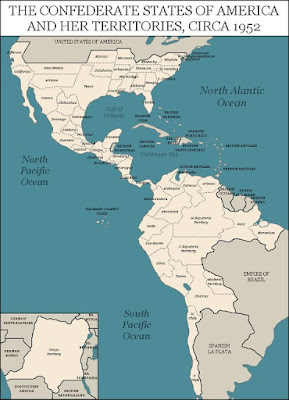
Proving that borders are imaginary–a hallucination that people choose to believe in–folks in Oregon want their border moved so they can be in Idaho, the same with some Illinois folks and Indiana. Shouldn’t be surprised. History books are full of maps showing how it all gets rearranged. With the exception of the U.S./Mexico border (Why? Hmm . . .), a lot of people want to redraw the maps again.


 File:Man High Castle (TV Series) map.png - Wikimedia Commons


Borders are not only imaginary, they are largely unnatural, created by human beings through conflict and self-interest. Where you see a straight line on a map, there are unresolved conflicts bubbling away.


And now the bubbles are reaching the surface, getting ready to burst.

This is what happens when you choose to deal with diplomacy with a chainsaw rather than a scalpel.


Now the gargoyles have taken over the cathedral, as I heard Ray Bradbury and Harlan Ellison say and each attributing it to the other, back when the Watergate scandal broke. This time the gargoyles are uglier, meaner and stupider. Muy estupido.


And it’s looking like the beginning of a bloody mess. I hope to Izpopalotl, the Goddess of Nightmares, that it’s just my sci-fi imagination running amok, but what’s a Chicano scifiista to do?


These changes are already having an effect on culture. Hollywood and the media are going chickenshit, will publishing follow? 


Guess I have to go underground again, a cultural desperado, using creativity as a weapon and displaying in weird, new venues. When the going gets tough, the tough get creative. Look out, here comes a whole lot of guerrilla worldbuilding. 


We need to re-draw some maps, and transform the landscape.


Welcome to New Aztlán, cabrones!


Mondo Ernesto: THE JUBILEE NOW


Ernest Hogan will be teaching “Gonzo Science Fiction, Chicano Style” via Zoom at Palabras del Pueblo Writing Workshop in June. The focus will be on aesthetic terrorism, creative blasphemy, and guerrilla worldbuilding. 

Wednesday, March 05, 2025

Wild Dreamers- Sueños salvajes


By Margarita Engle


Publisher: ‎Atheneum Books for Young Readers 

Language: ‎English

Hardcover: ‎224 pages

ISBN-10: ‎1665939753

ISBN-13: ‎978-1665939751

Reading age: ‎12 years and up

Grade level: ‎7 – 9


Longlisted for the National Book Award

A Pura Belpré Young Adult Author Honor Book


Ana and her mother have been living out of their car ever since her militant father became one of the FBI’s most wanted. Leandro has struggled with debilitating anxiety since his family fled Cuba on a perilous raft.


One moonlit night, in a wilderness park in California, Ana and Leandro meet. Their connection is instant—a shared radiance that feels both scientific and magical. Then they discover they are not alone: a huge mountain lion stalks through the trees, one of many wild animals whose habitat has been threatened by humans.


Determined to make a difference, Ana and Leandro start a rewilding club at their school, working with scientists to build wildlife crossings that can help mountain lions find one another. If pumas can find their way to a better tomorrow, surely Ana and Leandro can too.


Sueños salvajes 


Escrito por Margarita Engle 

Traducido por Alexis Romay e Inma Serrano 


Preseleccionado para el Premio Nacional del Libro


En este emocionante romance juvenil de la galardonada autora Margarita Engle, el amor y la conservación se entrelazan mientras dos adolescentes luchan por proteger la vida silvestre y sanar de sus pasados problemáticos.


Ana y su madre han estado viviendo en su coche desde que su padre militante se convirtió en uno de los más buscados por el FBI. Leandro ha luchado con una ansiedad debilitante desde que su familia huyó de Cuba en una balsa peligrosa.


Una noche de luna llena, en un parque silvestre en California, Ana y Leandro se encuentran. Su conexión es instantánea: una radiancia compartida que se siente tanto científica como mágica. Luego descubren que no están solos: un enorme león de montaña acecha entre los árboles, uno de los muchos animales salvajes cuyo hábitat ha sido amenazado por los humanos.


Decididos a hacer una diferencia, Ana y Leandro inician un club de rewilding en su escuela, trabajando con científicos para construir cruces de vida silvestre que puedan ayudar a los leones de montaña a encontrarse. Si los pumas pueden encontrar su camino hacia un mañana mejor, seguramente Ana y Leandro también podrán.


Review


"Emotions run deep and true in the concrete poems and free verse, which offer complex relationships that are familial, cultural, romantic, and environmental, appropriately blurring the lines between them for readers already invested in effecting heartfelt change." -- The Bulletin of the Center for Children's Books, Starred Review


"Distinctive verse by Engle portrays Ana and Leandro’s alternating perspectives to fully immerse readers in this sweetly rendered romance, adding depth to the teens’ parallel journeys. . . a heartwarming and inspiring eco-centric read that addresses timely issues such as conservation of wildlife and emphasizes the importance of people’s connecting to nature—and each other." -- Publishers Weekly


"Verse in various forms, including beautiful concrete poems, effectively conveys this story’s themes of sustainability, resilience, and activism. A transformative journey celebrating the power of overcoming personal struggles to make a lasting impact." -- Kirkus Reviews


Margarita Engle is the Cuban American author of many books including the verse novels Rima’s Rebellion; Your Heart, My Sky; With a Star in My Hand; The Surrender Tree, a Newbery Honor winner; The Lightning Dreamer; and Wild Dreamers, a Pura Belpré Young Adult Author Honor book. Her verse memoirs include Soaring Earth and Enchanted Air, which received the Pura Belpré Award, a Walter Dean Myers Award Honor, and was a finalist for the YALSA Award for Excellence in Nonfiction, among others. Her picture books include Drum Dream Girl, Dancing Hands, and The Flying Girl. Visit her at MargaritaEngle.com.


Tuesday, March 04, 2025

Guest Columnist Thelma Reyna: Octavia's Bookshelf Fire Fundraiser

A Roman God, History, and Poets: The Altadena Eaton Fire Revisited
Thelma T. Reyna
 
History is a bit like the mythological Roman god Janus, a two-faced being who simultaneously looked at the past and the future. Janus was thus the god of beginnings and endings, of necessary transitions and ongoing change. So, once history (the past) is made, what will be the ramifications (the future)? 

The Eaton Canyon fire that savaged the tightly-knit, artistic community of Altadena, CA, on January 7 made history as California’s second-most destructive fire ever. Its fury brought endings uncountable and unimaginable, and has spawned soul-searing transitions and changes that will affect our lives for generations and possibly forever. 

Luckily poets have been akin to first responders in this catastrophe. Since the beginning, in social media and reading events throughout SoCal communities—live, on-air, and virtual—, poets have brought their artistry and voices to navigating and parsing the losses and grief we have suffered. This past week, one such poetry event brought together stellar poets to address “history.” 

On Tuesday at Octavia’s Bookshelf in Pasadena, Altadena’s current Co-Poet Laureates, Sehba Sarwar and Lester Graves Lennon, presented their reading event, “After the Fire: Honoring Histories.” Billed as a fundraising event to benefit the Altadena Public Library, it included several distinguished poets.

Laureates & Award-Winners


Lester Graves Lennon

Lester Graves Lennon: current Altadena Co-Poet Laureate; author of three poetry books; Poetry Editor of Rosebud magazine. 

Sehba Sarwar

Sehba Sarwar: current Altadena Co-Poet Laureate; author of a novel and of poems published in various literary publications in Asia, Pakistan, and elsewhere. 

Teresa Mei Chuc

Teresa Mei Chuc: Altadena Poet Laureate Emerita; author of four books; member of the Pasadena Rose Poets; and Shabda Press book publisher. Her high school student, Riot, a member of Teresa’s Poetry Club, read two of his poems. 

Sesshu Foster

Sesshu Foster: author of six books; winner of the American Book Award, one of the top book prizes in the U.S.; winner of the Asian-American Literary Award for Poetry; winner of the Believer Book Award for speculative fiction.

Maryam Hosseinzadeh

Maryam Hosseinzadeh: a poet and community arts organizer in Altadena and other parts of Los Angeles county.

Cassandra Lane

Cassandra Lane: author of the award-winning book, We Are Bridges: A Memoir; winner of the 2020 Louise Meriwether First Book Prize; journalist with stories and essays appearing in newspapers and magazines, most notably as editor-in-chief of LA Parent magazine.

A Packed, Appreciative Audience


Nicky High and Nicki Winslow

Although Octavia’s Bookshelf is a cozy, compact reading venue, the diverse audience was packed and energized. The store’s owner, poet Nicky High, was present, along with Nicki Winslow, director of the Altadena Library District. The amount of library donations raised was not yet announced.


The poets varied in their emphasis on the fires but focused on themes of family roots in the area, losses in general, unity, and community spirit. Lennon, the current Co-Laureate, read a poem detailing the ubiquity of chimneys standing “proudly” amidst the ruins, vestiges of their centrality in the homes. Lennon also spoke in one poem about a memorable Christmas dinner his neighbor had hosted shortly before the fire and how, two weeks later, her house lay in ashes.  


Sarwar, also current Altadena Co-Laureate, read a poem describing a student’s stated hopes that fire victims would survive and prevail by “joining together,” and how she affirmed the student’s belief.


 Moving Forward:  Poets in Real Time, Writing “History”


The groundswell of poets sharing their observations, fears, grief, and dreams will likely continue as does the rebuilding of Altadena and Pasadena, for poets are the observers and reporters of the most consequential moments in life, the moments that most touch us, move us, and instruct us. May their artistry continue to enrich our community.